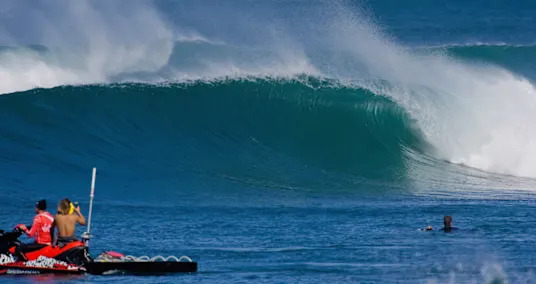
This iconic right-hand, point-break is nestled in an ideal location on the Surf Coast of Victoria to harness both wind and swell. Its reliable conditions have established it as a world-class competition venue and a treasured home-break for countless surfers over the decades. In this article, I'm going to dive into the key elements that have made this wave so legendary.
Swell Source
The Southern Ocean stretching between Australia and Antarctica, and extending west into the South Indian Ocean, is one of the most active zones on the planet for storm activity. These storms are strongest and most frequent from April through September (the Southern Hemisphere's winter months), but swell-producing systems can develop at any time of year.

Swell Window
Storms that develop a strong and well-aimed fetch between 224° SW and 196° SSW are ideal for Bells, as there are no obstructions for inbound swell. Due to the orientation of Bells (generally facing southeastward), incoming swell west of 224° will feel a degree of shadowing by Australia itself - the more west, the more it will be shadowed, and therefore less energy making it into Bells. Swells east of 196° will feel partial shadowing by islands off the coast of Tasmania, then blocked by Tasmania east of 175°.

Bathymetry
An offshore underwater ridge stretching to the south will help to refract a greater share of the inbound swell toward the gradually rising rock reef at Bells. While it isn’t a classic point break, the waves often act like one—concentrating their energy at the top of the reef where it peaks. From there, the local bathymetry takes over, guiding the swell as it refracts from the deeper bay into the shallower reef along the point, producing the long, clean right-hand lines Bells is known for.

Long-period swell (over 15-16 seconds) interacts more effectively with the bathymetry, allowing the energy to focus and wrap into the break with greater precision.
The ideal swell direction for shape falls between 215° and 196°. Swells arriving from farther west tend to produce flatter faces and break wider on the outside reef, missing the famed end bowl section. These conditions are often better suited to Winkipop, Bells’ neighboring break to the east.
When the swell comes from a more southerly angle, it strikes the top of Little Rincon—the section of reef directly below the Bells cliff—more directly. This produces a steeper, more hollow wave throughout, though it can also be faster and more sectiony down the line.

Wind
Given the general southeasterly exposure of the beach, straight offshore is from the northwesterly direction. Light to moderate offshore flow from the west through northwest is ideal, or calm to light/variable wind for glassy surface conditions.
High-pressure positioned to the north over New South Wales or Queensland, with its counterclockwise circulation, will deliver west to northwest winds to Bells.
While offshore for some other locations in the area, a N to NE wind is a “devil wind” at Bells and Winkipop, especially when moderate to strong. A light wind from the straight N is OK.

Best Specs
Swell Direction: SW to SSW (215-196°)
Swell Period: 15-16 seconds or longer
Surf Size: Chest-high to triple overhead
Wind: West to northwest
Tide: Low for the Bells Bowl and high for Rincon
This story was originally published by Surfer on Apr 2, 2026, where it first appeared in the News section. Add Surfer as a Preferred Source by clicking here.
latest_posts
- 1
 Was This Driver Simply Having Some good times Or Behaving Like An Ass?
 - 2Who is Adm. Frank 'Mitch' Bradley and what does he have to do with the Venezuela boat strikes?
- 3We may have less control over how long we live than previously thought
- 4The Solution to Innovative Peculiarity: Analyzing the Fate of Mankind
- 5Shrapnel hits across central Israel, injuring several, causing property damage





- NASA Perseverance rover sees megaripples on Mars | Space photo of the day for Jan. 7, 2026.
- Historical mysteries solved by science in 2025
- Reports: Germany plans expansion of foreign intelligence powers
- Blue Origin launches New Glenn rocket on company's first NASA-scale science mission
- Staggering Spots to Stargaze All over the Planet
- Activists: Venezuela released just nine prisoners despite promise
- WATCH: IDF strikes, dismantles missile launchers in southern Lebanon
- HGV driver recruited others to smuggle migrants
- Limited Rain Chances in Brazil Boost Coffee Prices